MAX
Подпишись
стань автором. присоединяйся к сообществу!
31 декабря 171
86

Тест обновлённой графической подсистемы и аппаратного 3D ускорения на процессоре Эльбрус-4С
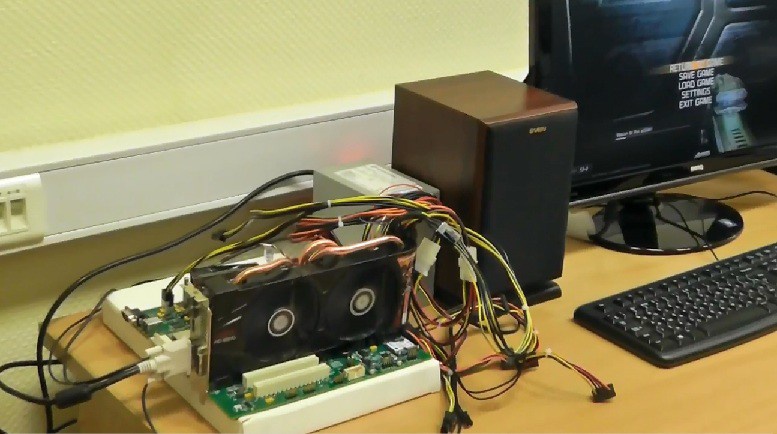
Перед новым годом сотрудники МЦСТ решили протестировать работу обновлённой графической подсистемы платформы Эльбрус, поддерживающей аппаратное 3D-ускорение. Для этого решили немного поиграть.

[читать статью полностью...]

Кстати, а вы знали, что на «Сделано у нас» статьи публикуют посетители, такие же как и вы? И никакой премодерации, согласований и разрешений! Любой может добавить новость. А лучшие попадут в наш Телеграм @sdelanounas_ru. Подробнее о том как работает наш сайт здесь👈

Источник: mcst.ru

Поделись позитивом в своих соцсетях

Комментарии 0

Для комментирования необходимо войти на сайт

  • 2
    sepheronx sepheronx31.12.14 21:58:19

    Very true but in terms of gflops technically, the Elbrus 4c is supposed to dominate even some newer chips. Comparing it to a processor that was made in 2002 on 180nm tech using DDR1 memory (none onboard control) is not very good at all, even for a starting chip. MCST got some pretty good funding from industry and trade ministry, so I would have expected better.

    I would be interested for someone to compare this to a core i3 running at same frequency with both just running 1 core, than the next test, woth all cores running, to get a better picture.

    • 1
      sepheronx sepheronx01.01.15 04:33:23

      You know, I was thinking of something. As I am not entirely sure about how games are technically developed, do video games ever take advantage of any of the instruction sets that are found on CISC processors like Intel and AMD? What I gather is that since Intel and AMD dominate the personal computer market, I gather that all video games using these platforms are using the instruction sets that are available on the processor. Although, this may not be the case as most instruction sets are hidden in the compiler as one would say. But my understanding is that, while the Elbrus architecture is a heavy number cruncher, it may be underpowered in these applications like gaming due to the fact that all these games are designed around a common CPU design (CISC) vs the Elbrus which is VLIW. Also, I do have to take account for the significantly lower frequency of the processor so it would be important to try to see how this processor would fair against lets say Core i3 at same frequency in various tests.

      Also, this processor was designed for both workstation use and server use (2C+ for radar and other systems that require extreme performance of translation of data from the radar to screen. Hence DSP cores on the chip; 4C+ for industrial use like auto CNC equipment and data servers and 8C for heavy workstation use and heavy server/supercomputer use), thus they do not probably have gaming in mind and require specific uses for it. That is why you would not see SPARC processors in a video game console but you saw a MIPS processor instead.

      Which brings me to another question: Why do they still bother with SPARC production? They should just stop its production and concentrate on the VLIW architecture and possibly work on their own MIPS architecture.

      • 0
        Нет аватара Vedomir01.01.15 13:42:20

        common CPU design (CISC)

        The difference is much wider. Both CISC (even if we forget, that since Pentium Intel x86 processors has RISC core with hardware translation CISC command to RISC) and RISC processors are from superscalar family, so even ARM, MIPS or SPARC are very defferent from Elbrus, only Intel Itanium has simular design. VLIW is very exotic in modern world, so it is really hard to compare its perfomance with x86 family.

      • 0
        shigorin shigorin01.01.15 14:14:22

        Elbrus performance does depend heavily on pipeline being tightly filled for ideally all of its currently six computing blocks *and* for optimized memory access as all of the pipeline would sit idle for those dozens of clock cycles of memory access (heard that from MCST guys at a recent OS Day miniconf in Moscow).

        And yes, they do bother with SPARC-based line (R1000) and have taken one of those to show us at that miniconf too (in addition to 2/4/8-core VLIW ones) :-)

        --

        Michael Shigorin

        • 1
          Нет аватара guest01.01.15 15:19:01

          Which is exactly where the lack of optimisation of Doom 3 source code comes into play. It relies heavily on Intel’s SSE instructions and inlines/intrinsics in the C source code — which was the real point of testing, as narration mentions: to see whether they would work at all, rather then test the performance — and its memory usage is clearly suboptimal. Still, that the game not only simply compiles, but is actually playable — is an achievement in and of itself. 800 MHz Pentium Ms of the era couldn’t run it at any reasonable speeds and even in 640×480 resolution it was basically a slideshow with 2−5 FPS, and even on 2500 MHz Pentium 4s it still ran equally choppily.

          Отредактировано: Andrey Tupkalo~16:29 01.01.15